Top Banner
- TomFolio.com
-


 Case/Case Bound: The covers of a hardback book consisting of the
entire outer cover including the boards and spine. The term originates from Case Binding which was
introduced in the early 19th century and enabled the mechanization of bookbinding. Traditionally, binding
was done by hand. The boards were attached to the
Textblock by cords, and then covered with
leather or paper (See Figure 20). The new
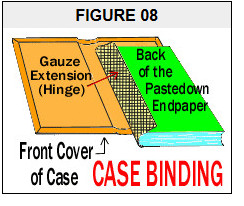
method (See Figure 8) allowed mass production by manufacturing the entire outer covers separately which
were then glued to textblocks. Still used today with minor variations, the process entails an adhesive
being applied to the spine of a textblock, a strip of gauze (stretch out an inch or so past the spine)
placed over the adhesive, a strip of thin cardboard glued over the gauze on the spine, and the cardboard
glued to the back of whatever is serving as the spine cover. The inside of the front and back covers of
the case are then glued to one side of the gauze extensions and the front and back endpapers to the other side.
The gauze extensions become the book's
Hinges.
Case/Case Bound: The covers of a hardback book consisting of the
entire outer cover including the boards and spine. The term originates from Case Binding which was
introduced in the early 19th century and enabled the mechanization of bookbinding. Traditionally, binding
was done by hand. The boards were attached to the
Textblock by cords, and then covered with
leather or paper (See Figure 20). The new
method (See Figure 8) allowed mass production by manufacturing the entire outer covers separately which
were then glued to textblocks. Still used today with minor variations, the process entails an adhesive
being applied to the spine of a textblock, a strip of gauze (stretch out an inch or so past the spine)
placed over the adhesive, a strip of thin cardboard glued over the gauze on the spine, and the cardboard
glued to the back of whatever is serving as the spine cover. The inside of the front and back covers of
the case are then glued to one side of the gauze extensions and the front and back endpapers to the other side.
The gauze extensions become the book's
Hinges.
 Chromolithography: A process for creating color prints and
book illustrations which evolved from the original process of lithography discovered in the late 1790s.
Lithography started with a flat stone which had been ground and polished and provided the surface on which
an image was engraved. Alternately ink-repellent and ink-receptive solutions were applied to the stone and
transferred to paper to create the black and white prints which were then hand-colored. Chromolithography
was discovered in 1837 and was a process of superimpositioning a series of at least three colors using a
separate stone for each color (See Figure 10). Each color is printed separately on the same sheet by
maintaining precise alignment. As many as 38 successive proof prints from 19 separate stones were used
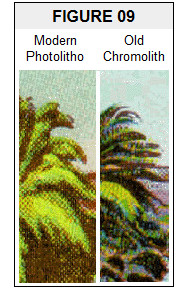
at the height of its achievements. Chromolithographs are identified by the distinct randomly placed
irregular dots visible on close inspection. Modern photolithographic methods produce uniform dots.
(See Figure 9).
Chromolithography: A process for creating color prints and
book illustrations which evolved from the original process of lithography discovered in the late 1790s.
Lithography started with a flat stone which had been ground and polished and provided the surface on which
an image was engraved. Alternately ink-repellent and ink-receptive solutions were applied to the stone and
transferred to paper to create the black and white prints which were then hand-colored. Chromolithography
was discovered in 1837 and was a process of superimpositioning a series of at least three colors using a
separate stone for each color (See Figure 10). Each color is printed separately on the same sheet by
maintaining precise alignment. As many as 38 successive proof prints from 19 separate stones were used
at the height of its achievements. Chromolithographs are identified by the distinct randomly placed
irregular dots visible on close inspection. Modern photolithographic methods produce uniform dots.
(See Figure 9).